Photo courtesy of Aston Martin Aramco F1 Team
Senna and Schumacher would have loved F1’s 2026 cars - Brundle
Martin Brundle believes the new generation of Formula 1 car would have been loved by legends such as Ayrton Senna and Michael Schumacher, because they had additional capacity to maximize performance.
The 2026 regulations have given drivers an increased workload through the additional battery power available, with a roughly 50:50 split between internal combustion engine and the electrical motor. That means regenerating the energy and where and when to deploy it has become an area of major focus, and Brundle – who started 158 grands prix prior to becoming a respected TV pundit – says the new demands on the drivers are still within the essence of F1.
“If you're going to go flat out for a long time, you've got to protect things,” Brundle said. “It's always been the same whether it was Stirling [Moss] and [Juan Manuel] Fangio back in the day, or Jackie [Stewart] and Graham [Hill] and Jim [Clark.
“Back then it was dog rings, drive shafts, universal joints, gearboxes in general, engines, suspension, rose joints, clutch – we were always protecting something. Even in the fearsome ’80s turbo days, we had 220 liters [58 gallons] of fuel, so we were lifting and coasting brutally through the entire race because that was the only way to get to the end with any kind of performance or fuel left at the end.
“I ran out going to the line once and lost third place in Adelaide because I wasn't careful enough on that. So you've always had to protect something along the way. Tires is a good one, especially these days.
“I actually think Ayrton and Michael would love these cars because they've got the capacity to use all the tools, and the people who knew how best to use the tools and get the best out of the cars [would succeed].
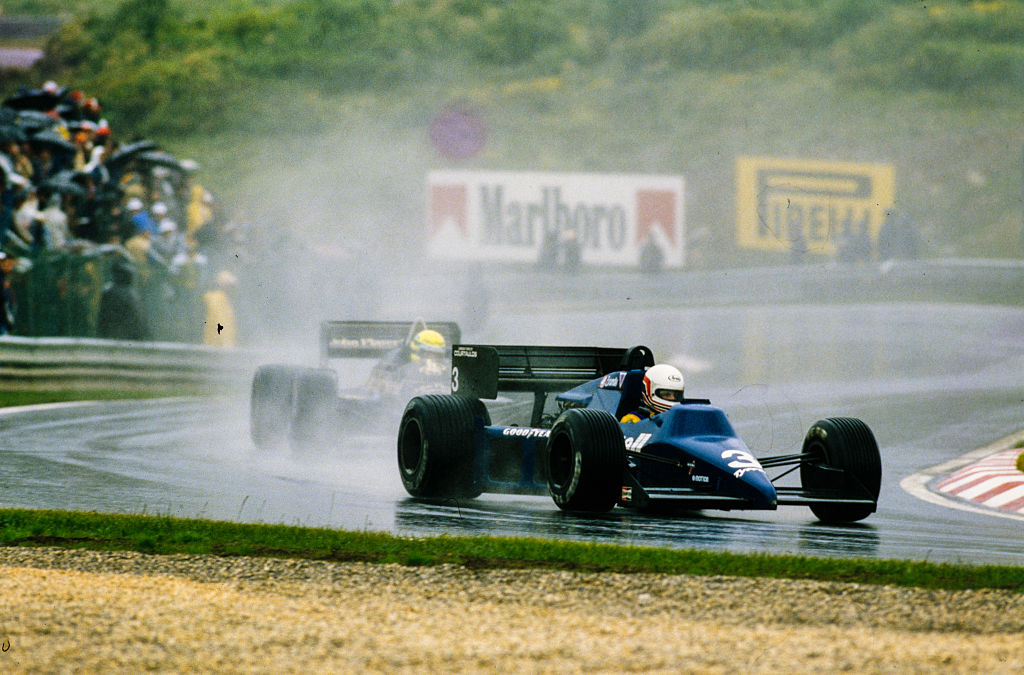
The specifics have changed a lot since Brundle – here in a Tyrrell 012 Ford ahead of Ayrton Senna's Lotus 97T Renault during the 1985 Portuguese GP – raced in F1, but he thinks the essence of the challenge remains with the current generation of cars. Getty Images
"I think what's happened is your universal joints and your brakes and your rose joints protection has now come to your battery, because the cars are bulletproof, aren't they, in many other respects. So I think the specific challenge has changed, but the overall challenge hasn't.”
Despite not being concerned that the driving challenge is being altered, given the potential speed differential based on when drivers deploy additional energy, Brundle is wary of the new regulations opening up lots of simple passing moves that could dilute the value of each.
“What I'm nervous about is four or five great overtakes in a race is wonderful to see. And over the years, sometimes that was a season – four or five great overtakes. We don't want a number of overtakes every race that looks like a basketball game score. But personally I don't think we’ve lost the essence, no.”
Chris Medland
While studying Sports Journalism at the University of Central Lancashire, Chris managed to talk his way into working at the British Grand Prix in 2008 and was retained for three years before joining ESPN F1 as Assistant Editor. After three further years at ESPN, a spell as F1 Editor at Crash Media Group was followed by the major task of launching F1i.com’s English-language website and running it as Editor. Present at every race since the start of 2014, he has continued building his freelance portfolio, working with international titles. As well as writing for RACER, his broadcast work includes television appearances on F1 TV and as a presenter and reporter on North America's live radio coverage on SiriusXM.
Read Chris Medland's articles
Latest News
Comments
Comments are disabled until you accept Social Networking Cookies. Update cookie preferences
If the dialog doesn't appear, ad-blockers are often the cause; try disabling yours or see our Social Features Support.